
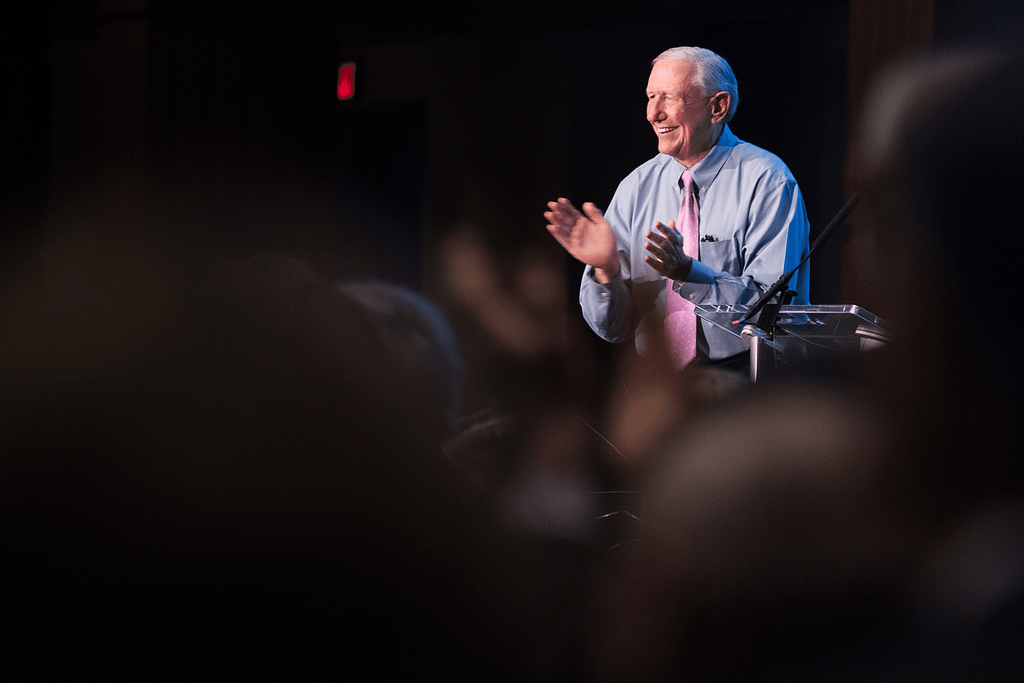
The following remarks were delivered by Head of School Chuck Webster at University High School’s 2016 Trailblazer Awards Gala on Saturday, August 27.
Welcome.
This is a great time to be at University High School, and it is a great night as we recognize the contributions of our honorees. We now have 309 students – 69 freshmen and 90 new students – and the quality of these incoming students is exceptional. Students of color now make up 32% of our student population.
In addition to those numbers, we have recently received confirmation of the school’s standing and impact from two significant sources. Tim Fish, the newly appointed National Association of Independent Schools (NAIS) Director of Innovation, was here in early August – he is coming back in a few months to see January Term – and while he came to speak to faculty and staff, he said, and I quote, “NAIS wants to determine how you were able to develop this school from scratch in under 20 years.” Tim Fish sees the very best schools in the country, many of them among the 1,500 NAIS schools. He was effusive about our school when he was here in August for a day and a half, and he wrote a very kind email after his departure.
John Gulla is the president of the Edward E. Ford Foundation. The E.E. Ford Foundation, whose offices are in Brooklyn, makes grants only to independent schools. John has visited over 500 independent schools in the past five years. The E.E. Ford Foundation awarded grants to 17 schools in June; University High School was one of them.
This confirmation by two seasoned, highly regarded national experts on how far University has come in such a short time is another way to understand what we all have accomplished here.
To the people who have brought us this great evening – thank you. To Susan Berry, our gala committee chair, to Jane Burgess, the auction chair, to the entire gala committee and to Adrianne Glidewell Smith – thank you for everything. Thanks to teachers and staff for donating over half of the auction experiences and to Mark Minner for being our wonderful emcee — Go Dawgs! Thanks to all of our sponsors for supporting this evening and to the parents, alumni parents, and friends of University for helping make this evening possible.
This is an extraordinarily generous community. You see it in the kindness, occasional grace, and obvious goodwill with which our students go about their lives. You see it in this extraordinary faculty and staff, whose investment, commitment, and level of engagement rises way beyond workplace dynamics. Years ago, a then-student with friends in the crowd tonight said, “Those teachers must all be phonies; no one can care this much about me.” They did, and they do. And in the words of another, the teachers actually believe all this stuff. They did, and they do. They believe beyond instruction and assessment, beyond assignments, matches played, and the daily grind. They believe infallibly in learning and in their students as exemplars of human expression. And they believe in each other. Anyone who comes to our school knows that human beings – young and not so young – are engaged in making the lives of other human beings better.
And this generosity of spirit that began with our founding Board extends to current parents, alumni parents, alumni, friends of University, and to the current University Board of Trustees. Your belief in and care for the mission and people of University have helped to build and sustain our school, and they have elevated and distinguished what has been accomplished here.
Thank you also to Jeff Lewis – founding Board member, current Board chair, and one of my partners in this remarkable journey. Almost 20 years ago, Jeff was the scribe for the University mission and the author of the core values, as well as the author of some of University’s best quotes. To the chair of our first visiting accreditation team, Jeff said, “I had no idea how much work this was going to be, how much it would cost, or how good the school would be.” And three years ago, when he was asking founding Board members to pony up once more, he led with, “This is the most important thing in my life that I have ever been a part of.”
And to my partner throughout this journey, Nancy Webster – thank you.
I would like to say an upcoming happy 50th birthday to Dr. Chris Cosby, who continues his recovery from a serious stroke. I note how many in this room have supported the Cosby family during their time of challenge. Welcome back to Jamie Napier, and welcome to Tom Rosenbluth, Head of The Orchard School. And I will say no more goodbyes, but rather deep-seated thanks to Jeannie Sager, whose incredible 11-year run at University included developing this event. Watching Jacob Sager beaming in the hallway as he begins his second-generation-Sager University journey is a wonderful thing to see.
Connection, commitment, accomplishment, and relationships that span the room – these are some of the many elements that resonate in the room this evening. Nancy and I were Chris Bradley’s English teachers for his 8th and 9th grade years at The Roeper School. Twelve years ago, Chris Bradley was Taylor Newell’s mentor. Now Taylor has his own commitments and accomplishments at University, and he has his own mentees. Every one of tonight’s award recipients, organizations and individuals alike, have affected the lives of University students, some for years before they were selected for recognition this evening. Connection, commitment, accomplishment, relationships that span the room.
This is a vibrant, complex community, mixing past and present, vision and values, and the contribution of individuals whose lifework has changed, saved, and enriched the lives of literally thousands. And there are our University student presenters, who along with their classmates have embraced and helped determine the value and meaning of the University High School experience. It is an honor to be with you all this evening.
Theirs were the first boots on the ground – Chris and Carolyn Bradley. I remember all of it: Chris’s phone call in 1999, their first trip down to what was then a soybean field, a dinner at Sandy and Cindy Lange’s. I had said to Sandy that if the Bradleys came it would change everything – I had no idea. Nancy, Chris, Carolyn, and I created the program architecture that we thought followed from the founding Board’s mission and core values statement. Morning meetings, mentoring, visible signs and symbols of trust and respect, and Chris’s schedule design made those mission twin-towers, expanding hearts and minds and nurturing excellence, actually viable. Carolyn was the January Term whisperer. It was her idea, I said no repeatedly, and then in those formative months, sometimes very softly, she just kept saying it. I can’t remember exactly when I broke down, but January Term has become University’s flagship learning experience, frequently our highest expression of what teaching and learning looks like at its very best.
The ideas that developed, the values that flourished, the love of the work – the Bradleys were front and center for all of that. And there is something else, something the four of us have become more aware of recently. There is a character that comes out of founding a school if you are successful; it is the wherewithal to stay the course no matter what because what you have helped create is that important, matters that much. That clarity of purpose and conviction for the work at hand is also part of the Bradley legacy.
I first met three of our honorees as they became University parents – Jan Ramer and Bob Newell 15 years ago, and Pat and Diane Healey roughly two years later. They have close to 20 years of University parenting between them. Sara Newell was in University’s first graduating class. Twelve years later, she is Sara Weaver, mother of baby Ben, the first grandchild of Jan Ramer and Bob Newell and also Taylor’s first nephew. The first time most of us heard Sara speak, several weeks into her first year here, was at a morning meeting held in the lobby of Andrews Hall in 2001 when Chris Bradley gently forced Sara to say something to the assembly. Nancy still remembers the soft, sibilant sound of Sara’s voice and the broad smile she exchanged with Chris when she finished. Sara spoke carefully and judiciously when she was a student here, but like that smile to Chris, she made connections of all kinds, beyond talk, that were high on the human being scale.
Taylor Newell was in our fourth graduating class. He was one of the most thoughtful, passionate-about-idea guys, one of the most intent learners in that class or any other. He graduated with high honors from Butler University and came back to his school. He is now the Assistant Director of Admission. Taylor had a gift for the trumpet. He played Dizzy and Miles, could cop Clifford Brown’s sound, played Monk and Art Blakey compositions with an obvious sense of understanding. His tone was the thing; his sound made you listen, made you feel, brought an emotional clarity to the moment. When I asked him later about why he no longer played much, he said that once he got to Butler, his mother was no longer there to make him practice. I always loved the briskness and inevitability of that response.
Taylor and I have had our exchanges as student and teacher. My practice in class, then and now, is to take the best papers from each assignment, ask permission of the author to hand out copies of their work, and then ask the author to read his or her paper. Taylor’s essay was in the top group for the first assignment, and the second, and then a third time later on. My first hallway conversation with Taylor did not go well. I was asking permission to pass out copies and to have Taylor read his paper. Taylor’s answers, in order, were, “Do you have to?” and “No I won’t.” He said it nicely. I think he agreed to read the second paper begrudgingly, and the third time we were in the hallway he just stared at me, knowing, I think, that it was a lost cause. His papers were that good. That was 2005.
That summer, Nancy got a completed application from a rising 8th grader. Nancy assumed, wrongly, that it was someone who wanted to skip 8th grade, that it was an application for the upcoming year. Not a chance. It was Sarah Healey’s application. Her mother had told her that she could apply to University but the process was entirely up to her. Sarah thought she would just get it out of the way, you know, a little early. So Sarah Healey is the earliest student ever admitted to University High School by a wide margin. She is also the most organized. In what would have been our fourth mentoring meeting in the fall of her freshman year, Sarah showed me something. I had no idea what it was; it was color-coordinated with plastic covers. It turned out to be a schedule of when Sarah was going to study for each one of her final exams for the next six weeks.
I am not an online guy – no Facebook, no texting, no blogs, except one. The year Sarah spent in Paris before she began her master’s degree at Columbia University, I read every post – for the food photography and the recipes, of course, but most of all for the continued sense of connection. Our mentoring schedule has slowed these days, since Sarah and Ted’s wedding and their work in New York, but I have no doubt that it will continue to be a part of our lives.
The Healeys always told me that they weren’t really looking at University for Sarah, but they had known that their second daughter, Erin, would need a different school environment. That is frequently coded speech for someone expected to struggle academically. However, Erin Healey is one of the brightest, most serious students ever to attend University. Her GPA here was a 3.7, and she is now in her second year of the MBA program at Purdue University. We started mentoring as school began in Erin’s junior year. As I headed toward my office during the first week of school, Jennifer was waving and scrunching and leaning my way, which usually meant someone had broken through the lines and was waiting in my office. Erin had been there for some time, next to the Kleenex box, sobbing. Then as she spoke, it was as if she took no breath at all – “I have just come from Precalculus. Everything I learned in Algebra II was wrong. I will never pass Calculus. I can never go to medical school. My life is ruined.” Later we decided that there might have been a rush to judgment in there somewhere and that perhaps her future was not completely lost.
In our next mentoring session, we were talking about summer. Erin had been on a trip to Israel with a student group. The much-shortened version of this story is that there were teenagers on the trip whose behavior, when they were unsupervised, probably included several lapses in judgment, and perhaps even a lapse or two in decorum. The upshot for Erin was that she would never travel again outside her family, and she would try to avoid unsupervised teenagers at all costs. The problem was that now into her junior year, she was falling in love with Spanish. Erin became one of the best students of the language in a very long line of great Spanish students here at University. So I said, why not ask Susana Bollinger about the IU Honors Program? She said it was too late to apply, and remember, no trips. I suggested that perhaps just a word with Susana would be permissible under the rules, and the rest we know. Erin went that summer to Ciudad Real. AP Spanish became her favorite class, Susana her favorite teacher, and her undergraduate degree included a major in Spanish.
Daniel Healey. When he received his Core Values Award, several faculty members cried. He is a shining example of our core values in action. His favorite teacher was Mike Hagan, University’s business manager, and their relationship is another example of what is best about us. Daniel made everything he engaged in better – cross country culture, school spirit. He was friends with all, gracious, and very, very funny.
I look forward to a great evening together. Thank you.
To view photos from the 2016 Trailblazer Awards Gala, visit the University High School Facebook page.