
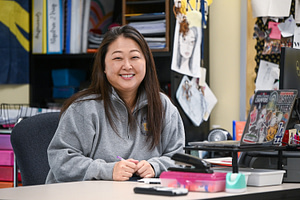
Early in her career, Jannie Kim discovered that teaching math was the highlight of her day. She wanted to teach math full-time but hadn’t studied it in college. “As a cognitive psych major, one of the big things I learned was how much potential our brains have. I thought, I can do this.” She self-taught and earned her math teaching certification.
Mrs. Kim shares this story with students to illustrate that being “a math person” isn’t a requirement for grasping math. She encounters students who enter her class, convinced they are bad at math. That’s when Mrs. Kim brings cognitive science into the equation.
“I am so intrigued about how brains work. The pathways we build between neurons are different when we make a mistake and learn from it. I want students to think not only about math but to understand the metacognition part. How do I learn? What are ways I can do this better?” She tells students, “Our brains are constantly forming and reforming. Keep working on the problem. When something doesn’t click the first time, try it a second time. Or third. Or fourth.”
In her Geometry classes, Mrs. Kim relates math concepts to daily life. “Once we build that interconnected network, it’s really hard for information to disappear versus just one neural pathway going to an isolated piece of information.”
Last fall, she showed students a photo of a costume she made. “Look, this is how we use math outside of the classroom. I had to calculate the arc length to figure out this bulge in the knee when I was sewing it together.”
During another lesson, Mrs. Kim challenged students to find the volume of an innertube she’d tossed on the floor. Despite not having learned a formula for such a problem, the students reasoned their way to possible solutions. “They were doing calculus-level thinking. I was so proud. They started thinking of it as slices of circles lined up. How many circles would it be? What is the length inside versus outside? I was amazed.”
In Jannie Kim’s classroom, cognitive science and creativity foster connections that result in moments. “Those are the moments I live for, where the students really get creative.”