
While in Baltimore for the NAIS Annual Conference, three University High School teachers set up site visits at two local independent schools, The Park School of Baltimore and McDonogh School.
Math at The Park School of Baltimore
Jenny Cox and Tom FitzGibbon spent a day visiting The Park School of Baltimore, which is a nonsectarian, independent, coeducational day school for children in pre-kindergarten through grade 12. The school of 829 students (346 in high school) describes its core values as “rooted in the progressive educational philosophy of John Dewey.”
Cox and FitzGibbon were hosted by Tony Asdourian, a math teacher at Park who explained their unique approach to mathematics courses. Asdourian attended The Roeper School and is a former student of Chuck Webster and a former classmate of Chris Bradley.
“The Park School’s math department is nationally known for its different approach,” said Cox. “They level their courses, so they have a 9th grade math class and all 9th grade students take that class. Those classes are then leveled, so in 9th grade, there would be 9-1, 9-2, 9-3, and 9-4 sections. The 9-1 section is for the brightest of the bright, 9-2 is for students who can kind of do it almost as well, then there is 9-3, and 9-4 is for students who really struggle with math.”
“The advantage [of that approach] seemed to be that the students felt more comfortable asking questions,” explained Cox. “When I think of my own classes, I have students who are pretty smart but who feel intimidated by the other smarter kids in the class and who don’t want to ask questions. In the 11-4 class I visited, they were raising their hands and asking questions, and I thought that was good.”
The reason Park is able to structure their courses this way is that they do not offer AP courses. And the math teachers worked together to develop this unique curriculum and write their own textbooks that feature more challenging, competition-style questions than a standard math textbook.
“They do not have AP courses,” said Cox. “This is something that I’ve thought a lot about. College Board is very picky, so The Park School has just chosen not to go through them. They still let their students take the AP exams if they want to, though. The only thing the teacher doesn’t have access to are the practice AP exams.”
Land Use at McDonogh School
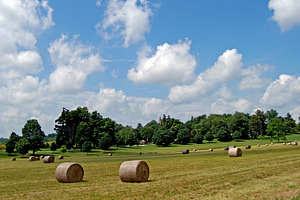 While Cox and FitzGibbon visited The Park School, Stacey Summitt-Mann spent the day at McDonogh School, which is 20 minutes away from Baltimore in Owing Mills, MD. Founded in 1873 as a farm school for poor boys, McDonogh School is situated on 800 pastoral acres and is a school for students in grades preK-12.
“McDonogh has a school farm,” explained Summitt-Mann. “And the way their farm director has integrated it is probably the best I’ve seen in all of my school visits. They have people coming out to the classroom and using it as a resource, but they also have it integrated with the community service program.”
Produce on the farm — primarily potatoes, tomatoes, and pumpkins — is donated to the local food bank as one form of service. The farm produces more than 5,000 pounds of food each year, and some is used in the school cafeteria, but the bulk is donated. Students also donate their time to work on the farm.
“Throughout their high school experience, students must get 40 hours of community service, and 25 of those hours can be done at the farm on campus to give back to the school. (The other 15 have to be “human hours,” serving people in the community.) She had a really neat model where after the 25 hours, she could then hire kids as interns.”
Overall, this site visit gave Summitt-Mann a greater appreciation of community partnerships that are made possible through the asset of land.
“I think it gave me a clearer picture of how other schools look at the local environment and local partnerships as a learning tool.”
Photo courtesy of the McDonogh School website.