
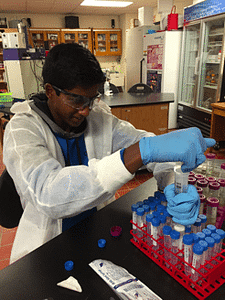
 University High School sophomore Jay Maturi will be one of just 18 Indiana high school students to compete in the Intel International Science and Engineering Fair (Intel ISEF) from May 8-13, 2016 in Phoenix, AZ.
Maturi’s research project, titled “Effects of Chlorella algae on mortality rates of zebrafish exposed to methylmercury,” earned second place among all 10th grade entries at the 28th Annual Hoosier Science and Engineering Fair on Saturday, April 2 at IUPUI. In addition to qualifying for the international fair, Maturi also won a plaque and $300.
Maturi’s project was inspired by his interest in e-waste. When electronics, such as televisions, computers, and cellphones, are improperly disposed of, they can leach chemicals (such as mercury and lead) into the environment. These chemicals can damage natural resources and harm animals.
Through his research, Maturi wanted to see if he could minimize the damaging effects of these chemicals. To do so, he put zebrafish embryos in various concentrations of methylmercury, a substance that the U.S. Geological Survey considers the most toxic form of mercury. In some of the wells, Maturi introduced the green algae Chlorella, which is thought to have a protective effect against mercury.
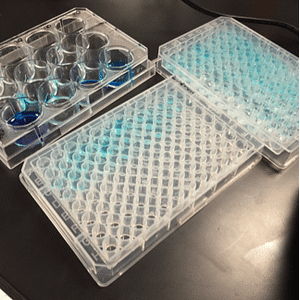 Maturi ultimately found this to be true in some cases. When measuring mortality rates, length, and hatching rates, the zebrafish in wells with Chlorella and high concentrations of methylmercury fared better than the others.
Maturi’s project will compete with more than 1,700 high school students from more than 75 countries in the Intel International Science and Engineering Fair next month. Intel ISEF is the world’s largest international pre-college science competition.
Intel ISEF unites these top young scientific minds, showcasing their talents on an international stage, where doctoral level scientists review and judge their work.